White label event app
Your event app, published under your own name
Attendees search the stores for your organization and download your app, not ours. Your name, your icon, your colors, your content. Who is Georges runs underneath and stays out of sight.
In short
What white label means here
White label means your own app, with its own listing on the App Store and Google Play, under your organization's name, with your logo, your colors and your content. Attendees never see our brand: they download yours. And it is one app you keep from one event to the next, not a new download every year.
Published on


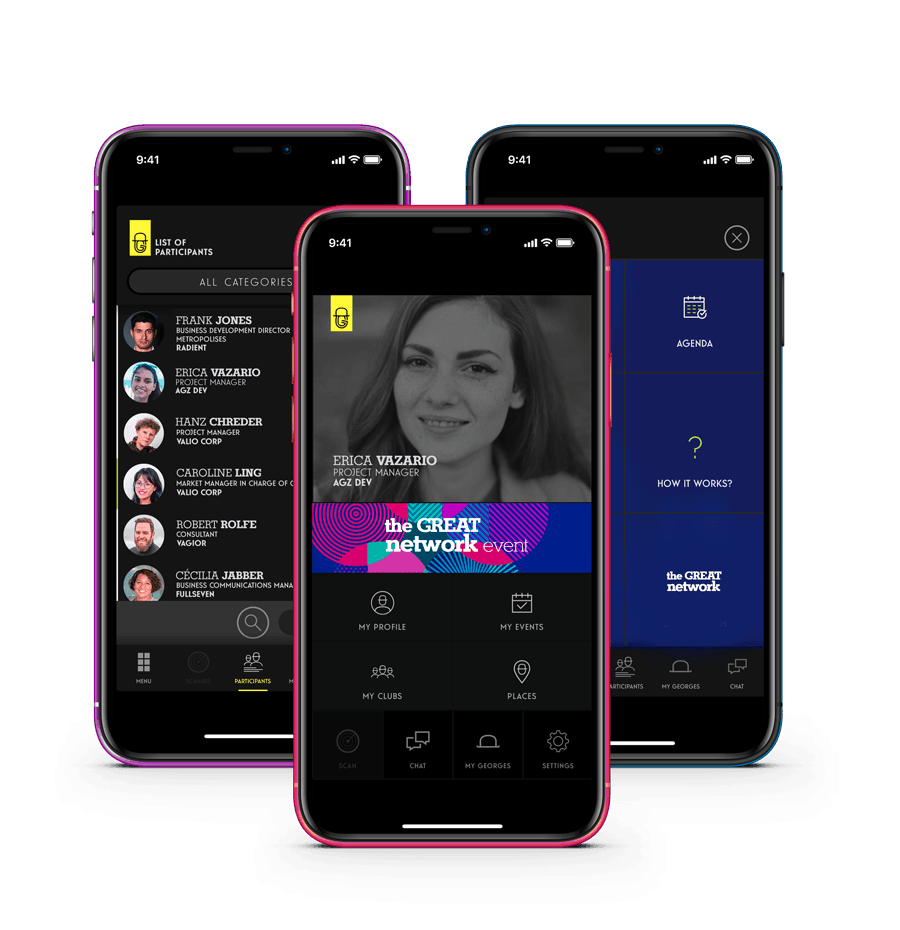
What you get
Your app, not ours with your logo on it
Your own store listing
Your app has its own page on the App Store and Google Play, with your name, your icon, your screenshots and your description. Attendees find it by searching for your organization.
Your logo, colors and fonts
The interface is built on your brand: logo, color palette, typography, splash screen — down to the icon on the attendee's home screen.
Your words, in your languages
Section names, labels and notifications follow your wording. The app is multilingual, and custom fields let you ask your attendees your own questions.
The whole platform underneath
Offline mode, matchmaking, messaging, meeting scheduling, check-in and check-out, live questions, polls, news feed, exhibitor portal — with or without Smart Ruby badges. The branded app is the full product, not a trimmed-down version.
Your back office and your exports
You run the app from the organizer dashboard: attendees, custom fields, SMS and email campaigns, satisfaction survey, Excel and PDF exports, and a documented REST API.
Your data, hosted in the European Union
Attendee data is hosted in the European Union and stays yours. GDPR is part of the setup, not an add-on.
The three levels
Not every branded app is a white label app
Vendors use the same words for three very different things. Here is where we stand.
The usual option
The container app
One app for all of the vendor's clients. Attendees download the vendor's app and type an event code. Your logo shows up once they are inside. Your name is nowhere on the stores.
What we do
The real white label
Your own app, published under your name on both stores, with your icon and your branding from the very first screen. The same platform underneath, so you get every feature and every update.
Another budget entirely
Custom development
An app built from scratch for you. Full freedom, a development project to run and maintain, and nothing to reuse from one event to the next.
Publishing one app per client is real work: a build, a store listing, a review, an update cycle for every client. When the stores tightened their rules on template-generated apps, a number of vendors dropped white label and moved everyone onto a single container app. We kept it, and we still publish apps under our clients' names.
Who it matters for
White label is decisive when the app carries your brand promise
Tour operators and travel organizers
Your travelers bought the trip from you. The app in their hand on departure day has to be yours — your name on the icon, your colors on the screen.
Group travelClubs and member networks
The app is the club, all year round. Members open your directory, not a vendor's app with a code to type in.
Business clubsOrganizations running several events a year
One app, published once, carrying your whole calendar: seminars, conventions, road shows. Attendees keep it installed between events.
Corporate eventsGroups with a strict brand policy
Communications and brand teams that cannot ship a third-party app to their people. The white label app clears brand review because it is yours.
What it takes on your side
What we need from you
White label is not extra work spread over months. It is a handful of decisions, taken once.
Your brand kit
App name, logo in vector format, colors, fonts. If you have brand guidelines, they are enough.
Your sign-off on publishing
Publishing under your name takes one decision on your side: the app name, the store listing, and how the submission is set up. Apple's review guidelines govern apps built from a template or an app generation service (rule 4.2.6), and we tell you on the first call what that means for your event. We prepare the build, the listing and the assets, and the listing carries your organization's name.
Your store listing material
A description, a few screenshots, an icon. We prepare them from your brand kit; you approve them.
Time before the date
Store review is handled by Apple and Google, on their own timing. We submit well ahead of your event and handle the back-and-forth with the review teams.
Track record
Apps that shipped, events that ran
+100
events equipped
94%
of attendees downloaded the app (SPIE seminar, 2018)
Organizations that ran their events with Who is Georges
- SPIE
- MMA
- Engie
- Vinci
- Worldline
- Arrow ECS
- TEDx Champs-Élysées Women
- Paris&Co
Getting started
Your branded app in three steps
- 01
Send your brand kit
Name, logo, colors. One call is enough to settle the rest.
- 02
Approve the app
We build your app, your store listing and your screenshots. You see it on a real phone before anything is submitted.
- 03
Publish, then reuse
The app goes live on the App Store and Google Play under your name. Every event after that is added from the back office.
FAQ
White label, answered plainly
Let's put your name on your event app
Tell us your brand, your calendar and your next date. Pricing is by quote: we come back with a proposal and a plan for the store submission.
Request a quote